The Shadow in the Stable: Unmasking the Culture of Bullying in Equestrian Sport
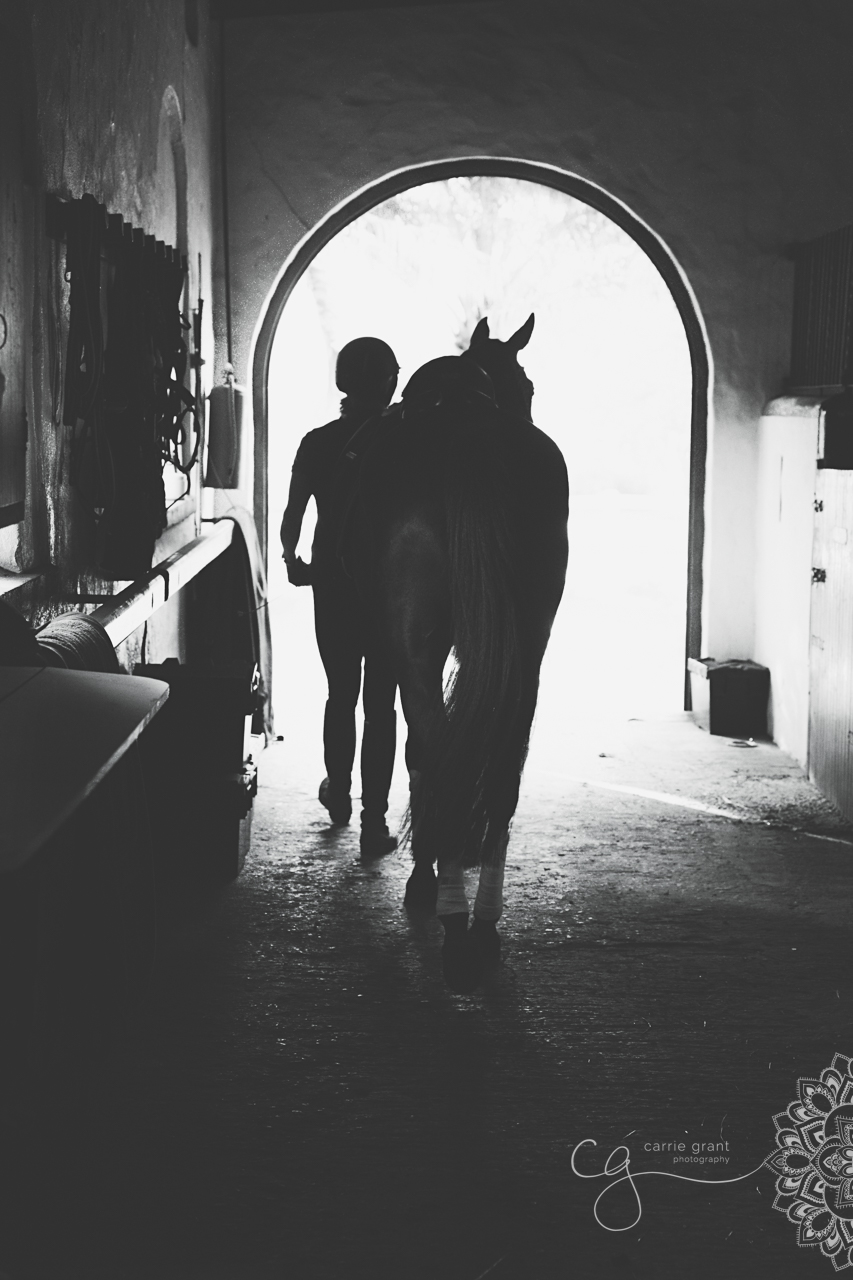
She came into the stable where I was cleaning out my horse’s feet. I was a little startled at first, but she started talking quietly, and it seemed that she was just making conversation. It started off friendly enough, and she even acknowledged that she could see that I really cared about my horse.
So it came as a total surprise when I found myself backed up against the back stable wall and she was hissing in my face that I was abusing my horse by choosing to keep him shod. Or by taking his shoes off. I can’t actually remember which one she stood for. I tried both options with this particular horse.
I remember the feeling well though. I felt powerless. Degraded. Humiliated.
In the moments of that interaction, all my worst fears about myself and the shame I felt as a human, flooded my being and I couldn’t get away fast enough.
As I made it out into the sunlight, tears stinging my eyes, taking great gulps of fresh air, I was able to reflect on what just happened. I know, because of my training as a coach, that this was really much more about her, than it was about me, or anything I had or hadn’t done. That her wild and unhinged accusations were really her trying to work though some long repressed trauma in her own life.
But.
They landed for me. And I took them on. Because there was enough of a grain of truth in what she said, that I couldn’t ignore that the same thought had crossed my own mind. I had doubted myself with this horse and his feet. I didn’t have all the answers.
Many of us have a similar story to tell. Perhaps it wasn’t a stable wall; perhaps it was a scathing comment on a Facebook post about your bit choice, or a whispered remark from the rail as you struggled with a lead change.
In the equestrian world, bullying often masquerades as "advocacy." We justify our aggression by claiming we are "speaking for the horse." But as I stood there in the dust of the yard aisle, my heart hammering against my ribs, I knew this wasn't about horse welfare. This was about power.
The Anatomy of the "Hook"
Why did her words—as unhinged as they were—paralyze me? As a coach, I talk a lot about the "Grain of Truth" theory. Bullying in our sport is rarely effective if it’s 100% false. It works because it finds the one door we left unlocked: our own self-doubt.
I had already agonized over those hooves. I had stayed up late reading articles, consulting farriers, and second-guessing my decisions. When she hissed that I was "abusing" my horse, she wasn't providing new information; she was simply amplifying the "Inner Critic" that already lived in my head.
Research in social psychology suggests that this is why equestrian bullying is so uniquely damaging. A study published in the Journal of Applied Sport Psychology highlights that because our identity is so deeply tied to our role as "caretakers," any accusation of failing the horse feels like a total assassination of our character. We don't just feel like we made a bad choice; we feel like we are "bad people."
The Tall Poppy Syndrome: When Success Becomes a Target
Bullying doesn't only happen when we are struggling; often, it’s most vitriolic when we are winning. We see this play out at shows and in the higher tiers of the yard hierarchy.
You’ve seen it: a rider works tirelessly, finally gets a string of lovely horses under her, and starts doing well. Suddenly, the "friends" who used to have coffee with her in the tack room are whispering in the warm-up arena. They aren't talking about her talent; they are talking about her "luck," her "wallet," or making subtle jabs about how she must be "over-horsed."
This is "Tall Poppy Syndrome"—a social phenomenon where people of high status are resented, attacked, or "cut down" because they have outpaced the group. In the yard environment, this is a form of social policing. By turning on the successful rider, the group attempts to pull her back down to their level so they don't have to face their own feelings of inadequacy.
The Bully-Victim Continuum: A Blurred Line
It’s easy to point at the woman in the yard and label her the villain. But if we are being intellectually honest—the kind of honesty required for true coaching—we have to acknowledge the "Bully-Victim" cycle.
In many cases, the bully and the victim are two sides of the same coin. Research into sports dynamics shows that horizontal violence (aggression directed at peers) often stems from a lack of agency. When we feel powerless in our own lives—perhaps we are struggling with our own horse, or feeling pressured by a trainer—we often externalize that anxiety by "policing" others.
Sometimes, we are the victim. But have there been moments where we, too, have been the judge? Have we looked at a peer who just bought a world-class horse and felt that sting of "it’s not fair," allowing that feeling to turn into a cold shoulder? That "at least I didn't buy my ribbons" sentiment is the seed from which bullying grows.
Why the Equestrian World?
Why is our sport such a fertile ground for this? We have to look at the socio-ecological framework of the yard.
Yards are often "closed systems." They are high-pressure environments involving significant financial investment, physical danger, and intense emotional attachment. When you mix those ingredients, the "Tribalism" instinct kicks in. We find safety in groups that do things "our way," and we perceive anyone doing things differently—or doing things better—as a threat to the safety of the herd.
A 2021 study on equestrian cultures noted that "the horse becomes a status symbol of the rider’s competence." Therefore, if your horse is shod (or barefoot) and mine isn't, your choice feels like a silent critique of mine. If you are winning and I am not, your success feels like my failure. To defend my ego, I must attack your method or your character.
The Trauma Behind the Hiss
As I made it out into the sunlight, tears stinging my eyes, taking great gulps of fresh air, I was able to reflect on what just happened. I know, because of my training as a coach, that this was really much more about her than it was about me.
In psychology, this is called Projective Identification. The woman cornered me because she was likely working through some long-repressed trauma in her own life. When we realize that the bully is often a person in a state of high-alert, nervous-system dysregulation, the power dynamic shifts. They are not "strong" and "dominant"; they are "fragile" and "reactive."
Breaking the Cycle: Strategies for the Arena
If you are dealing with this in your yard or at shows, how do we move forward?
Own Your "Grains": Identify your areas of doubt before someone else does. When you are confident in your process (even if you don't have all the answers), a bully’s words have nowhere to land.
The "Not About Me" Mantra: When friends turn on you after a win, ask yourself: What is the "unmet need" this person is expressing? Usually, it's a need for significance or a fear of being "left behind."
Set the Stable -Door Boundary: You do not owe anyone an audience for their vitriol. It is perfectly acceptable to say, "I am not open to discussing my horse's management with you right now," and walk away.
Check the Mirror: We must audit our own "inner bully." Are we celebrating our friends' "string of horses," or are we waiting for them to fail so we can feel better?
From Shame to Solidarity
The shame I felt in that yard was a heavy, suffocating thing. But shame cannot survive being spoken. By sharing these stories, we take the power away from the "hissers" and the "judgers."
The goal isn't to be a perfect horseman—that doesn't exist. The goal is to create a community where we can be vulnerable about our lack of answers and celebratory of each other's successes, rather than attacking each other to hide our own fears.
The "Social Cold Shoulder": When the Warm-Up Arena Becomes Frigid
Perhaps the most insidious form of bullying in our sport isn’t the hissed accusation; it’s the silence. It’s the moment you realize that the group of friends you used to ride with is suddenly huddled in a circle at the show, and when you approach, the conversation dies.
It happens most often when you start to succeed. When you move up a grade, or when that "string of lovely horses" begins to yield results. This is the social cold shoulder. It is a calculated move designed to make you feel that your success has cost you your community.
Research into Relational Aggression (often referred to as "hidden bullying") shows that this behavior is used to maintain social hierarchies. By excluding you, the group is trying to punish you for "stepping out of line" or outshining them. It’s a way of saying: You can have the ribbons, but you can’t have us.
Navigating the Show-Ground Freeze
When you are standing alone, while your former "team" is laughing ten yards away, the shame can be overwhelming. You begin to wonder if you’ve changed, if you’ve become "arrogant," or if you don't deserve the horses you have.
But remember: Their exclusion is a reflection of their limitation, not your character.
To navigate this, we need a tactical approach that protects our mental game and our horse’s performance:
Acknowledge the Grief: It hurts to lose friends. Don't "coach" yourself out of the feeling. Acknowledge that it is sad that their capacity to be happy for you was smaller than you thought.
Focus on the Primary Relationship: At a show, your most important "friend" is the one with four legs. When the social environment gets cold, turn your focus inward to your horse. They don't care about the yard politics; they care about your heartbeat and your hands.
Build a "Satellite" Support System: If your immediate circle turns on you because of your success, it is time to look further afield. Seek out other "Tall Poppies"—riders who are also working hard and succeeding. They understand the weight of that string of horses and won't resent you for it.
Scripts for the "Turning Point"
When the bullying moves from silence to subtle jabs, or when you feel the atmosphere shift in the tack room, having a pre-rehearsed script can save you from falling into the "powerless" trap I felt against that yard wall.
Scenario 1: The "Backhanded Compliment" at the Show
The Jab: "Must be nice to have such an expensive string of horses; it certainly makes the classes easier, doesn't it?"
The Script: "I feel incredibly lucky to have them. I’ve put a lot of work into getting here, and I’m really enjoying the journey with each of them. How is your horse feeling today?"
Why it works: You acknowledge your gratitude (taking the sting out of the 'privilege' accusation) while firmly reclaiming your hard work.
Scenario 2: The Cold Shoulder in the Yard
The Jab: You walk in, and the group stops talking and disperses.
The Script: (Don't follow them). "Morning everyone! Hope you have a great ride."
Why it works: You remain the "emotional adult" in the room. By staying polite but not "chasing" their approval, you keep your power. You are showing them that your self-worth isn't dependent on their huddle.
Scenario 3: The Direct Confrontation (The "Hisser")
The Jab: "I can't believe you're doing [X] with your horse. It’s clear you don't care about them."
The Script: "I hear you have strong feelings about this. However, I’ve made this decision with my vet and farrier, and I’m comfortable with my choice. I’m not looking for feedback on this right now."
Finding Your "Herd"
The woman who cornered me in the yard thought she was attacking my horsemanship, but she was actually attacking my sense of belonging. The same happens when friends turn on you at shows.
We have to realize that our "herd" isn't necessarily the people who happen to keep their horses at the same yard as us. Our herd is made up of people who share our values, not just our postcode.
If you are being bullied because you are doing well, or because you are making brave choices for your horse, take heart. The sunlight outside that yard is big enough for everyone. Take a deep breath of that fresh air, look at those lovely horses you’ve worked so hard for, and remember: You don't need to shrink yourself to make others feel tall.